



ABOUT THE CCF
The Combined Cadet Force (CCF) is a Tri-Service uniformed youth organisation in schools and colleges around the United Kingdom.
There are over 250 schools with a CCF around the UK. Most of these in the independent sector, although Contingent numbers within the state sector are increasing and a number of independent schools now work in partnership with a local state school.
The CCF was created on 1 April 1948 by the amalgamation of the Junior Training Corps and the school contingents of the Sea Cadet Corps & Air Training Corps. It is administered by the Ministry of Defence.
However, it is not part of the Armed Forces and its members are not liable for service or compulsory training in the Armed Forces.
The aim of the Combined Cadet Force:
To provide a disciplined organisation in a school so that its members may develop qualities of:
- Self-discipline
- Responsibility
- Self-reliance
- Endurance
- Resourcefulness
- Perseverance
- Leadership
The CCF also encourages a positive attitude to service to the community.
Members are neither encouraged nor discouraged from military service upon leaving school, but can be provided with advice and guidance on a career in the armed forces, if sought.
The Hume Report in 1987 described the CCF as:
"An immensely worthwhile organisation and it definitely plays its part in complementing the academic aims of a school in preparing young boys and girls for adult life" ...
"...The CCF provides a means to help youngsters to know themselves; it teaches leadership, team spirit and the qualities of good citizenship. It provides adventure and challenge where often a pupil who may not be the greatest success in the classroom or on the playing field achieves success in the Corps in one aspect or another.."
Army & RAF Training Syllabus
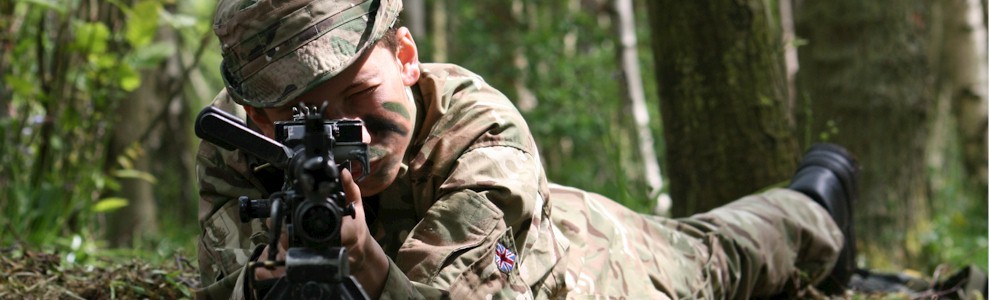
The different sections naturally have different syllabuses, but also have a certain amount in common. All cadets are trained to fire the L98A2 Cadet General Purpose Rifle and receive instruction in field-craft, navigation, drill, leadership and first aid.
Army Section cadets are badged The Rifles Regiment and able to specialise in various subjects such as signalling and infantry tactics. The Army Section also has courses such as advanced weapons theory, Royal Signals training, Royal Engineers and Royal Electrical and Mechanical Engineers courses.
RAF Section cadets are given the opportunity to fly in both powered aircraft and gliders. Their training and flying courses are similar to those available to members of the Air Training Corps. There is also the potential to be put forward for a solo flying or gliding licence if a cadet shows the right qualities and willingness.
Cadets of all sections can undertake leadership courses at Frimley Park, Nesscliff or RAF Cranwell, as well as adventurous training.